How to Play: The Basics
ChessVS is real chess plus a card layer. This page covers the core loop — what actually happens on each turn.
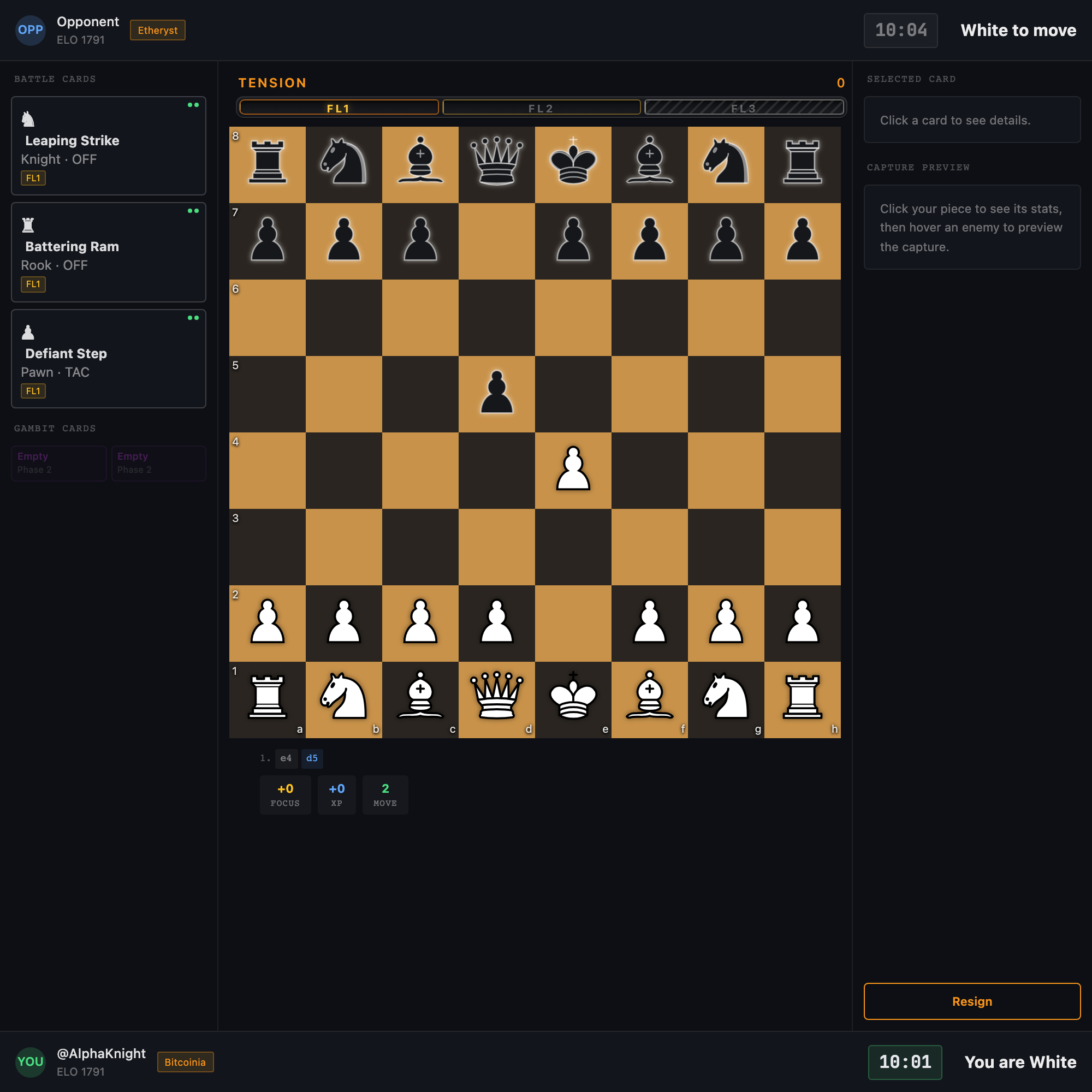 This is what a live match looks like: the board stays in the middle, your cards sit beside it, and the move strip keeps the record of every move.
The win condition never changes
You win by checkmate, exactly as in standard chess. Cards can delay, disrupt, and create chances — but they cannot win the game for you. A lost position stays lost.
Remember this whenever a card tempts you: the board is the boss.
A turn, step by step
Each turn has up to five steps. In a casual match you'll often only use steps 4 and 5.
| Step | Name | What happens |
|---|---|---|
| 01 | Prime | Review your hand and the Tension Gauge. Decide your plan. |
| 02 | Gambit | Optionally play a Gambit Card (arriving in a later season). |
| 03 | Declare | Optionally activate a Battle Card ability tied to a piece. |
| 04 | Chess Move | Make a legal chess move. This step is mandatory. |
| 05 | Resolve | Captures, ability effects, and stat changes apply. The turn ends. |
You must make a legal chess move every turn (step 4). Cards are optional — you can play an entire match as pure chess if you want.
Battle Cards vs Gambit Cards
ChessVS is built around two card types, one live today and one arriving in a later season. Here's the difference at a glance:
- Battle Cards are tied to a piece type (Knight, Bishop, etc). They give that piece a repeatable ability with limited charges. They make up your main deck. (Battle Cards →)
- Gambit Cards (arriving in a later season) are one-shot tactical plays. More details will be shared closer to release. (Gambit Cards →)
Piece stats: ATK and SHLD
In ChessVS, captures aren't always instant. Pieces carry two stats:
- ATK (Attack) — how much damage a piece deals when it attacks.
- SHLD (Shield/Health Points) — how much damage a piece can absorb before it falls.
Most captures still resolve immediately, just like normal chess. But certain cards and abilities interact with ATK and SHLD — for example, weakening an enemy piece's shield so a later attack finishes it. Pawns and Kings don't have an ATK bar; they rely on position and protection.
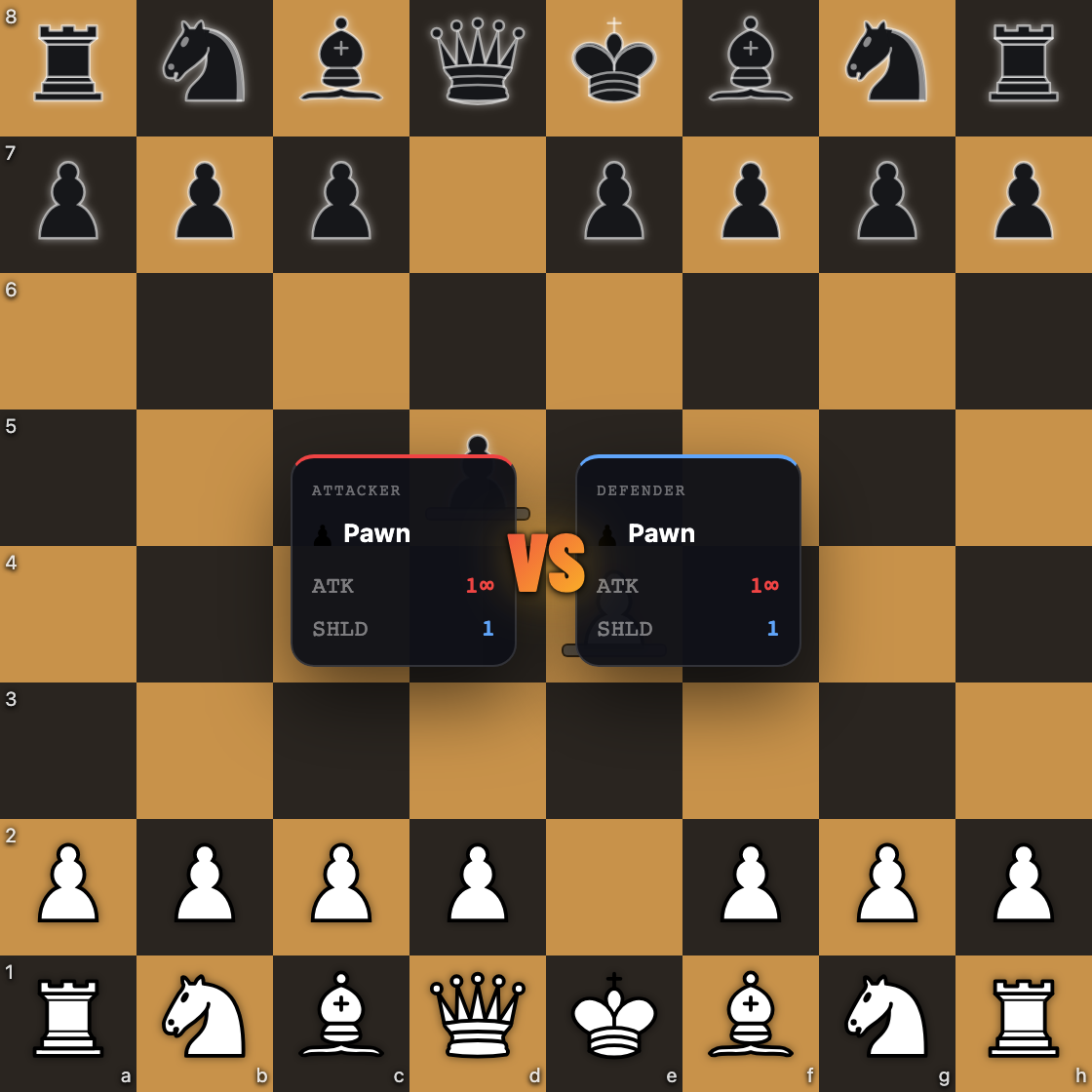 When a capture resolves, the attacking piece and the defender each show their ATK and SHLD plates so you can see exactly why the piece falls or survives.
You'll see two small segmented pip bars under each piece showing its current ATK and SHLD. Full pips mean a healthy piece; a pulsing empty bar means a piece on its last legs. Every clash is also written into the move strip with a battle glyph — see Reading the Battle Record.
The Tension Gauge
Above the board sits the Tension Gauge. It rises as the match gets more aggressive — captures, checks, and bold play push it up. Your most powerful cards are locked until the gauge reaches their required level.
This means early game is calm and positional; late game, with the gauge high, the dramatic swing cards come online. (Full explanation →)
Card categories: OFF, TAC, DEF
Every card ability is tagged with one of three categories so you can read at a glance what it does:
- OFF Offensive — pressures, attacks, or removes enemy pieces.
- TAC Tactical — repositions, sets traps, manipulates information or charges.
- DEF Defensive — protects, fortifies, or buys time.
A good deck mixes all three.
Your first match plan
- Play the opening as normal chess — develop pieces, control the center.
- Hold your cards. Don't burn them early just because you can.
- Watch the Tension Gauge climb.
- When the position gets sharp, use cards to swing a key moment — break a pin, save a piece, force a trade.
- Convert your advantage with clean chess. Checkmate ends it.