Battle Cards
Battle Cards are the heart of ChessVS strategy. Each one attaches to a piece type and gives that piece a special ability you can use during a match.
What every Battle Card has
- A piece type — Pawn, Knight, Bishop, Rook, Queen, or King.
- A Focus Level (FL1, FL2, FL3) — sets when in a match the card can be used. (Tension Gauge →)
- A category — OFF, TAC, or DEF — tells you at a glance what kind of effect it has.
- A rarity — Common, Rare, Epic, or Omega.
- A charge count — how many times you can use it per match.
- Uses (durability) — how many ranked or tournament games it can play before it is spent.
Press and hold any card, in your tray or in your collection, to see it full size. Full rules ▸ opens its complete rules text.
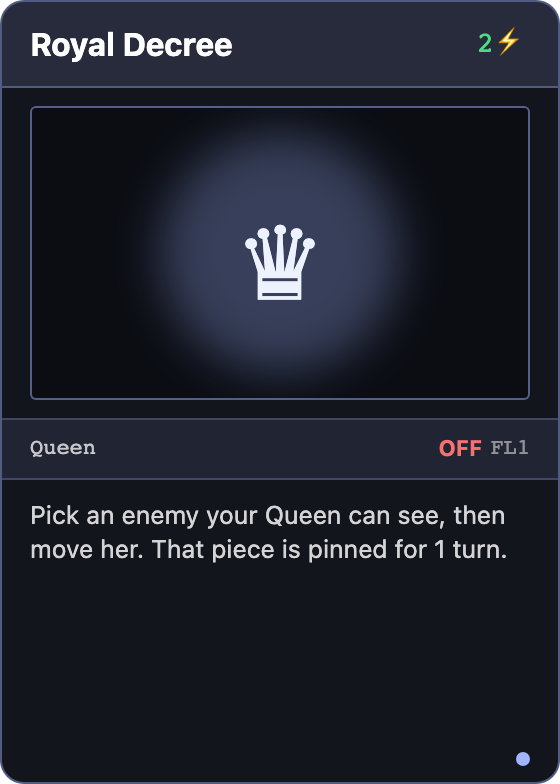
Every Battle Card shows its piece, role, Focus Level, and effect at a glance, so you know exactly what it does before you put it in your deck.
Focus Levels
| Level | When it unlocks | Power |
|---|---|---|
| FL1 | Always available | Solid, reliable effects |
| FL2 | Tension Gauge reaches 8 | Significant mid-game swings |
| FL3 | Gauge reaches 15, plus ELO ≥ 1,400 | Game-changing, one charge per match |
A card still waiting on the Tension Gauge can sit in your deck — it just can't fire until its level unlocks. A Level 2 or 3 ward stays shut until its level unlocks: it keeps its charge, stays face down, and only you see a short pop-up saying what it needs.
Live now: 44 designs
Every card below is in the game today, 22 at Focus Level 1, 13 at Level 2 and 9 at Level 3. Level 3 cards are on sale, but they need a 1,400 rating. Below it, your loadout shows them locked with "Needs rating 1400" and you can't arm them. At 1,400 or above they ride in your loadout and fire once your Tension Gauge reaches 15.
| Piece | Focus Level 1 | Focus Level 2 | Focus Level 3 |
|---|---|---|---|
| Pawn | Defiant Step, En Passant Lock, Stonewall, Vanguard | Spearhead, Underpromotion | Promotion Rush |
| Knight | Leaping Strike, Outpost | Knight Errant, Warp Strike | Spectral Fork, Waypoint |
| Bishop | Fianchetto, Pinpoint, Sanctum, X-Ray | Diagonal Surge, Overload | Color Trespass, Long Diagonal |
| Rook | Battering Ram, Bulwark, Forced Retreat, Open File Declaration, Tower Guard | File Claim, Siege Tower | Rank Sweep |
| Queen | Home Court, Light Court, Royal Decree, Royal Escort | Absolute Pin, Infiltration, Sortie | Radiant Threat |
| King | Adjutant, Fortify, Royal Guard | False Retreat, Nightwatch | Creator's Will, Rampart |
The three categories
Every ability is tagged so you can build a balanced deck:
- OFF Offensive — attacks, pressures, removes enemy pieces.
- TAC Tactical — repositions, traps, manipulates charges or information.
- DEF Defensive — fortifies, protects, buys time.
Charges per match
| Level | Charges | Deck slots |
|---|---|---|
| FL1 | 2 per match | One card per piece |
| FL2 | 2 per match | One card per piece |
| FL3 | 1 per match | One card per piece |
A loadout holds one Battle Card per piece at each Focus Level: six pieces, three levels, up to 18 cards. A Knight FL1 card and a Knight FL2 card ride together; two Knight FL1 cards cannot.
FL3 cards have exactly one charge on purpose — knowing when to spend it is the whole skill.
Rarity and durability
| Rarity | Uses |
|---|---|
| Common | 8 |
| Rare | 14 |
| Epic | 20 |
| Omega | 30 |
A card's durability is how many games it can be brought into, counted in uses. A Bitcoinia edition of a card gets one extra use on top of the table.
Every card in your loadout spends one use in each ranked or tournament game you play, win or lose, whether you fire it or not. A ranked game that pays you no FOCUS (too short, or past your daily cap) costs no use, and neither does a tournament game under 8 moves. Quick, Casual, friendly and AI games never cost a use.
A card with zero uses left is spent. It stays in your collection but sits out until you Refocus it: open the card in your collection and choose Refocus, at 10 FOCUS per use restored. At season end, Common and Rare cards reset to zero, Epic cards bank up to half their remaining uses (at most 5) to claim next season, and Omega cards keep all their uses.
Pick a card's rarity, its edition and how many uses it has left to see what a Refocus costs and what happens to it at season end:
Uses & Refocus calculator
43 FOCUS
5 × 10 = 50, less 15% for a full restore (7 off, rounded down)
A Common card resets to 0 uses left. It stays in your collection, spent until you Refocus it.
Uses: Common 8, Rare 14, Epic 20, Omega 30; a Bitcoinia edition holds one more. Refocus costs 10 FOCUS a use (9 for an Etheryst edition), and restoring every missing use takes 15% off. The math is the game's own.
Losing the piece costs the card nothing. Its charges belong to the card for the whole match, so it can still fire on another piece of that type. Whether the game uses up one of the card's uses depends only on the game (see the rules above), never on what happened to the piece.
ATK and SHLD
Every piece carries two combat stats, ATK (attack) and SHLD (shield), that come into play when pieces clash on the same square. A card's rarity never changes them: rarity buys how many uses a card has and how it looks, never how strong your pieces are. When a card changes a piece's stats mid-match (Vanguard's extra attack, Royal Guard's extra shield), a tab on the piece's square shows the bonus, red for attack and blue for shield, and the fight shows it in gold beside the piece's own number. On the stat bars under a piece, gold marks only points above its normal maximum.
- The Queen is the heaviest hitter at 5 ATK and 5 SHLD; the Rook (3/4) and Knight (3/2) sit in the middle, and the Bishop is 2/3.
- Pawns and Kings deal exactly 2 damage, and no fight lowers it. Nothing raises the King's. A Pawn's rises only through Vanguard, one point for each capture it wins with the card armed, up to 4; promotion ends the bonus. The Pawn carries 1 shield and the King carries 5, so they win through position and protection, not raw power. See Combat.
Your cards and your opponent's
Your cards. In a match, each of your Battle Cards is outlined in its club's color, with the club's crest. Universal cards keep a plain outline. A card you arm fills in; its outline never changes.
Your opponent's cards. Tap the ⬇ tab beside Battle Cards to pull your opponent's cards down over yours, and tap it again to put them away. Until a card is played you see only its piece and its Focus Level. A card shows in full once it fires, or when an effect reveals it. Your opponent never sees which card you declared, and you never see theirs.
At the end of the match, the results screen shows both players' cards in full, with how many times each one fired or fizzled.
Two editions of one card. If you own a card both as a universal copy and as your club's edition, choose which one plays on the card selection screen. The match plays the one you pick.
Card activation rules
- One ability per turn.
- Initiative and Tactical cards must be armed or declared before your chess move.
- When a card acts through your move, the card and the move must use the same piece.
- Charges are consumed on activation — whether or not the ability achieves its goal.
- Defensive and Reactive cards fire automatically when their trigger happens.
- Your loadout locks when the match starts — no swapping mid-game.
Rule 1 applies to every player in every club. Etheryst's passive, First Light, makes the first card an Etheryst player fires each match cost no charge (arriving in a later update); it will not add a second ability in a turn.
The Phase 1 starter cards
Every player receives three Focus Level 1 cards when they finish their first match, one each for the Knight, the Rook, and the Pawn. Each is armed before your move and uses a charge when it fires, whether or not it gets what it wanted.
| Card | Piece | Category | What it does |
|---|---|---|---|
| Leaping Strike | Knight | OFF | Your Knight survives the capture it starts, then holds one turn of immunity. |
| Battering Ram | Rook | OFF | Your Rook's move pushes the piece on its destination one square further along the same line instead of taking it. |
| Defiant Step | Pawn | TAC | Arm it, then capture with a pawn: the capture becomes a shove. The target is pushed one square back toward its own side, not removed. Unarmed, a pawn capture is an ordinary capture. |
A shove has its own rules. If the square behind the target is occupied, the move becomes a fight: an ordinary one for Defiant Step, and one where your Rook hits with +2 ATK for Battering Ram. If the target has nowhere left to go (off the edge of the board, or a pawn pushed onto its own back rank), it is removed. And Defiant Step never fires on en passant.
Pinpoint (Bishop), Royal Decree (Queen) and Fortify (King) are ordinary Level 1 cards: look for them in the Card Shop or on the Card Market.
Royal Decree holds an enemy piece for a turn. If Royal Decree, Absolute Pin or En Passant Lock would leave you no legal move, the freeze lifts for that turn and the game tells you: the lock mark comes off the piece and a line on your board says it is free this turn. A protection (Fortify, Leaping Strike) gives way first; a freeze lifts only if you're still stuck. In check nothing lifts, so checkmate stays checkmate.
The card collection
Every card design comes as a universal copy or as a club edition, in four rarities. The collection grows as more clubs arrive in future seasons.
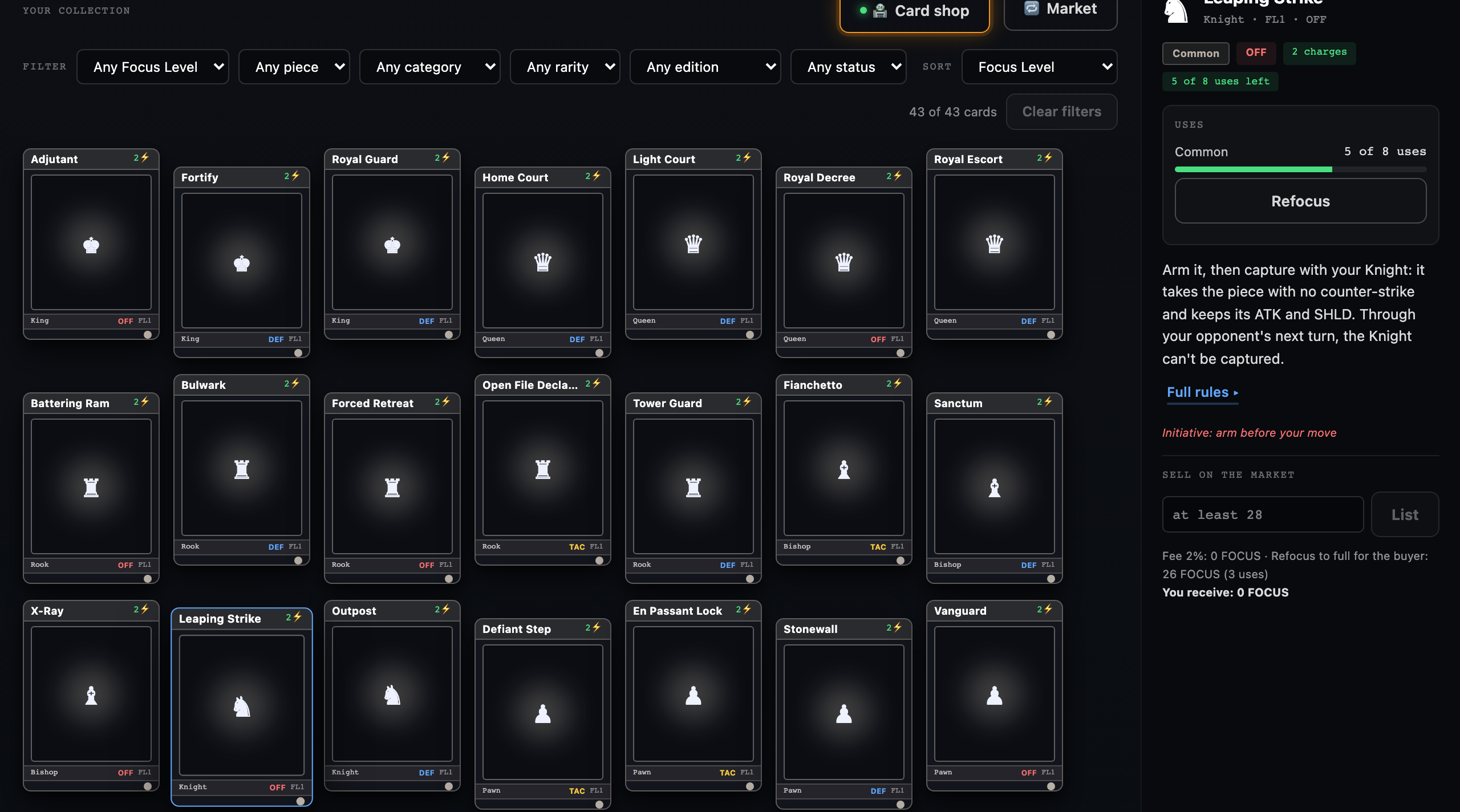 Your collection lays your cards out side by side so you can compare pieces, roles, and Focus Levels while building a deck. Click a card to see its uses (with Refocus when some are missing), a short summary of what it does, and Full rules ▸ for the complete text.
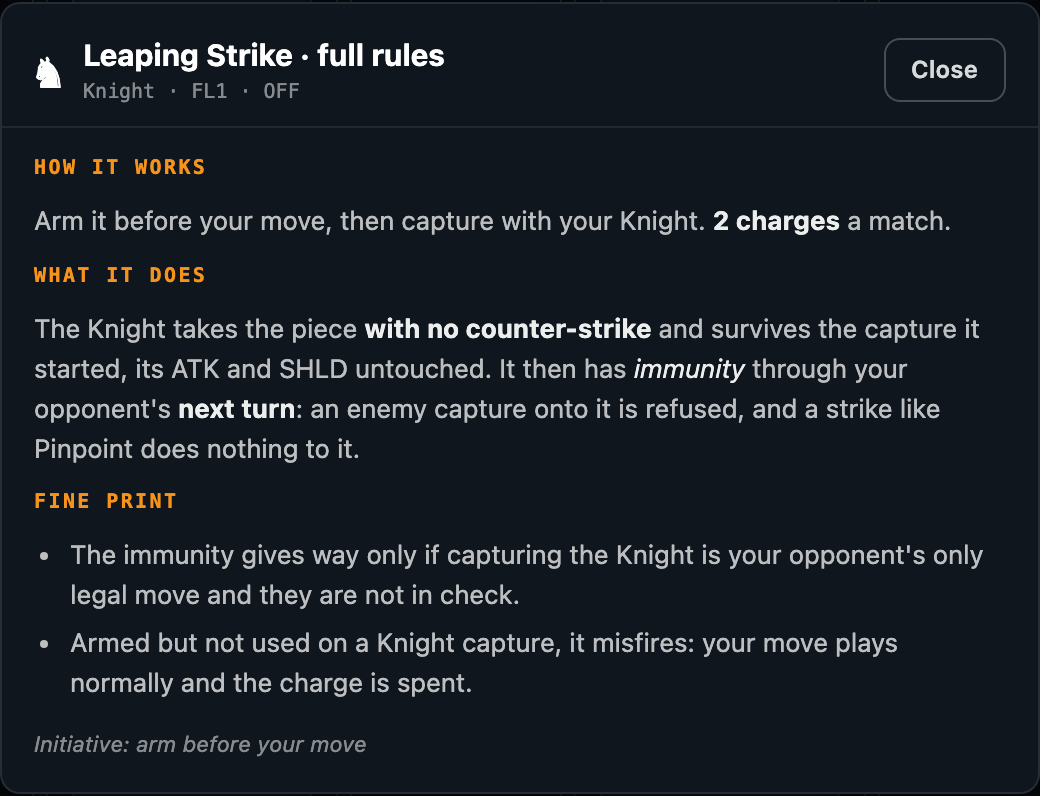 Full rules opens the card's complete text over the page: how you play it, what it does, and the fine print.