The Tension Gauge
The Tension Gauge is the in-match meter that decides when your stronger cards can be used. It fills as the match gets more aggressive and resets to zero at the end of every match.
Your gauge and theirs
Each player has their own gauge. Yours moves only from what happens to you:
- On your move: a capture +1, a check +2, a card ability +3, a quiet move −1.
- On theirs: losing a piece −1, and being put in check −1 (you begin your next turn in check).
Your gauge is the big Tension bar above the board. Your opponent's gauge is the thin strip marked OPP right under it, in their club's color, on desktop and on a phone alike. You can see when their stronger cards are coming: their middle cell lights at 8 (FL2) and the whole strip ignites at 15 (FL3). If their rating is under 1,400, a small lock sits on their strip, because their FL3 cards can't fire yet.
Pick whose move it is, then press an event.
Live demo of the two gauges in a match: yours is the big bar, your opponent's is the thin OPP strip under it, in their club's color. A capture or a check also costs the other player 1. A bar lights when that level's cards can be used: FL1 from the first move, FL2 at 8, FL3 at 15, when the whole gauge ignites.
| Term | What it is |
|---|---|
| Tension Gauge | The in-match meter on this page. Fills through play. Resets every match. |
| Focus Level (FL1/FL2/FL3) | A permanent property of a single card. Sets the gauge level needed to use that card. |
| FOCUS | The in-game currency. Spending it on your Tempo raises your starting gauge value, but it's separate from the gauge itself. |
How the gauge moves
Each match begins with your gauge at your starting value (today every player starts at 0). It then rises and falls based on what happens on the board:
| Event | Gauge change |
|---|---|
| You capture a piece | +1 (any capture) |
| You deliver check | +2 per check |
| You activate a card ability | +3 |
| You lose a piece | −1 |
| You are put in check (you begin your turn in check) | −1 |
| You make a quiet move (no fight, no check) | −1 |
A quiet move is one where nothing fights and nobody is in check. A capture attempt that leaves both pieces standing, or one where your attacker falls, is still a fight, so it never counts as a quiet move. If your attacker falls, you lose 1 for the lost piece, like any other piece you lose. Losing a piece drains the player who lost it, whoever moved.
 Your captures and checks push your gauge higher. At 8 the FL2 bar lights up, and at 15 the whole gauge ignites in your club's color. The thin OPP strip under it is your opponent's gauge, here at 4.
The gauge has a floor of 0 — it never goes negative. Even if you're losing badly, you stay at FL1 access rather than dropping below it.
Card unlock levels
Each card has a Focus Level (FL1, FL2, or FL3). The gauge must reach that level before the card can be activated. Cards from a locked level can sit in your loadout — they just can't fire yet. If the gauge drops back below a threshold, those cards lock again.
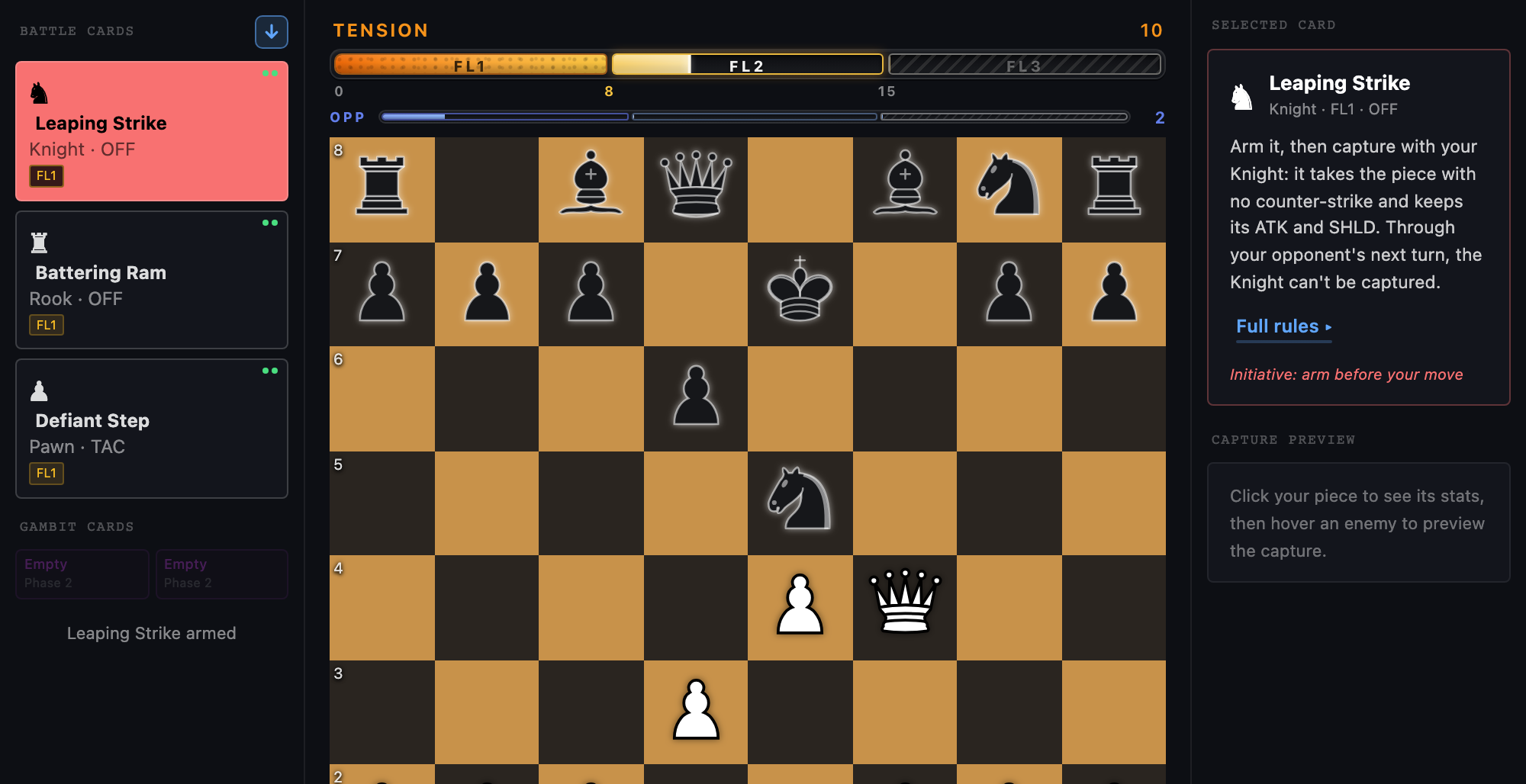 Once the gauge lights a card's Focus Level bar, that card can be armed during the Declare step.
| Card level | Gauge needed | Notes |
|---|---|---|
| FL1 | 0 — always available | Your everyday cards |
| FL2 | 8 | Mid-power cards unlock once the match heats up |
| FL3 | 15 + ELO ≥ 1,400 | The dramatic swing cards — also gated by skill |
FL3 cards are the most game-changing in ChessVS. They unlock only when the gauge hits 15 and your account ELO is at least 1,400. This keeps the most powerful effects in the hands of players who have demonstrated chess skill — you can't simply buy your way to them.
The five-step turn and the gauge
The gauge ties into the standard turn sequence:
| Step | Name | Gauge interaction |
|---|---|---|
| 01 | Prime | Check your gauge level and plan accordingly. |
| 02 | Gambit | Play an optional Gambit Card (Gambit Cards arrive in a later season; skip this step for now). |
| 03 | Declare | Activate a Battle Card ability (only if its FL is unlocked). Your opponent never sees which card you declared. |
| 04 | Chess Move | Make your legal chess move. |
| 05 | Resolve | Effects resolve; captures and checks adjust the gauge. |
Ability timing
Every card names its timing, and it fires at a different moment in the turn:
- Initiative: arm it before your move; it fires with that move.
- Tactical: declare it before your move; it fires only if the move meets its condition.
- Defensive: never played; it waits face down and fires on its own when its trigger happens.
- Reactive: fires automatically when its trigger happens (Fortify's is your castling), with no declaration needed.
Tempo
Your Tempo sets your starting gauge value, giving you a head start toward FL2 and FL3. It never locks anyone out — every player can reach every level through good play.
| Tempo | Starting gauge | FOCUS earn rate |
|---|---|---|
| Debut (default) | 0 | Standard |
| Midgame | 5 | Boosted |
| Finale | 10 | Boosted further |
Every player starts at Debut, at 0. To upgrade, tap the Tempo chip on your profile and choose Upgrade: Midgame costs 5,000 FOCUS and Finale 9,000 more, paid only from FOCUS you earned by playing. At the start of each new season your Tempo drops one level rather than resetting all the way down: Finale becomes Midgame, Midgame becomes Debut. So the head start is a per-season investment, but climbing back is cheaper than starting over.
Don't dump all your cards early to "pump the gauge." Play solid chess, let the gauge climb naturally, and time your FL2/FL3 cards for the moment they actually swing the game.